

Walk down the sleep supplement aisle (or browse online) and you’ll quickly notice something: there are lots of options — gummies, capsules, sprays — all with different ingredients promising better sleep. But what do these ingredients actually do, and how do you know which one might suit you?
This guide breaks down the most common sleep supplement ingredients, explains how they’re commonly used, and helps you understand which ones may align best with your sleep challenges — without the jargon.
Whether you struggle to fall asleep, stay asleep, or simply want to wind down more easily at night, understanding the ingredients is the first step.
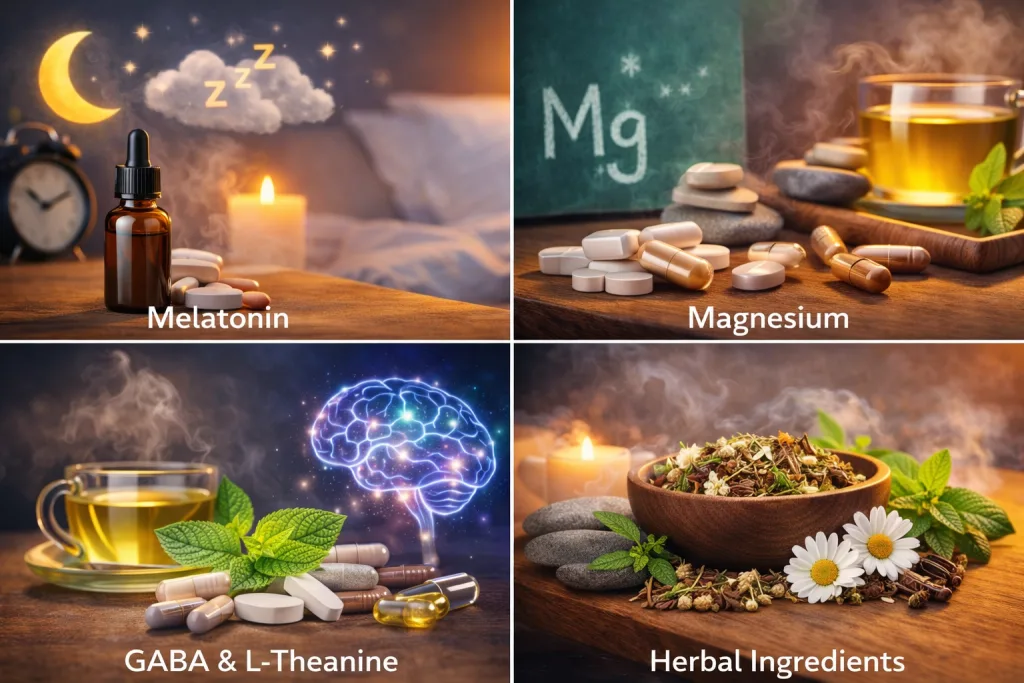
Melatonin: The Sleep Timing Hormone
Melatonin is one of the most well-known sleep ingredients — and for good reason. It’s a hormone your body naturally produces in response to darkness, helping signal that it’s time for sleep.
What melatonin is commonly used for
Melatonin supplements are often chosen by people who:
- Have difficulty falling asleep
- Experience jet lag
- Have irregular sleep schedules (shift work, late nights)
- Feel “tired but wired” at bedtime
Rather than acting like a sedative, melatonin supports the body’s natural sleep-wake cycle, also known as the circadian rhythm.
Who melatonin may suit
Melatonin tends to work best for short-term or occasional sleep disruption, rather than long-standing sleep issues. Lower doses are often preferred, as more isn’t always better.
Magnesium: The Relaxation Mineral
Magnesium plays a role in hundreds of processes in the body, including muscle relaxation and nervous system function. For sleep, it’s commonly associated with helping the body unwind physically and mentally.
Why magnesium is popular for sleep
Many people choose magnesium when sleep problems are linked to:
- Stress or tension
- Restless feelings at night
- Muscle tightness or cramps
- Difficulty switching off
Certain forms — such as magnesium glycinate or citrate — are often used in sleep supplements because they’re generally well tolerated.
What to know
Magnesium isn’t a quick “knock-out” ingredient. It’s often used consistently as part of a bedtime routine to support overall relaxation.
GABA: Supporting Calm Before Bed
GABA (gamma-aminobutyric acid) is a neurotransmitter naturally present in the brain. Its role is linked to calming neural activity, which is why it often appears in relaxation and sleep formulas.
When GABA is commonly used
GABA is often included in supplements for people who:
- Feel mentally overstimulated at night
- Experience racing thoughts
- Struggle to relax even when physically tired
Rather than directly inducing sleep, GABA is commonly used to support a calmer state before bedtime.
L-Theanine: Calming Without Drowsiness
L-Theanine is an amino acid naturally found in green tea. It’s widely used in both daytime stress products and night-time sleep blends.
Why people like L-Theanine
L-Theanine is often chosen because it:
- Supports relaxation without heavy sedation
- Helps ease mental chatter
- Can be combined with other sleep ingredients
It’s particularly popular among people who want to feel calm but not groggy.
Herbal Sleep Ingredients: Traditional Plant Support
Many sleep supplements include botanical extracts that have been used traditionally for relaxation and sleep preparation.
Common herbal ingredients you’ll see
- Chamomile – often associated with relaxation and bedtime routines
- Lemon Balm – traditionally used for calmness and stress support
- Valerian Root – commonly included in night-time herbal blends
- Passionflower – traditionally linked to relaxation
These herbs are often used together in low doses to support a gentle wind-down rather than a strong sedative effect.
5-HTP: Supporting Natural Sleep Chemistry
5-HTP is a compound that the body uses to produce serotonin, which plays a role in mood and sleep regulation.
Why some people choose 5-HTP
It’s sometimes used by people whose sleep issues may be linked to:
- Stress
- Low mood
- Difficulty maintaining sleep
Because 5-HTP interacts with neurotransmitter pathways, it’s generally advised to be cautious when combining it with certain medications.
Vitamin B6 & Supporting Nutrients
Some sleep supplements include supportive nutrients like vitamin B6, which plays a role in neurotransmitter activity and melatonin production.
While these nutrients aren’t sleep aids on their own, they’re often included to support the body’s natural sleep processes.
How to Choose the Right Ingredient for You
Instead of asking “what’s the best sleep supplement?”, it’s often more helpful to ask:
What’s keeping me awake?
Here’s a simple way to think about it:
- Trouble falling asleep? → Melatonin, magnesium
- Racing thoughts or stress? → GABA, L-Theanine, herbal blends
- Light or broken sleep? → Magnesium, calming botanicals
- Occasional disruption (travel, stress)? → Low-dose melatonin or blends
Everyone responds differently, and many people find that combination formulas work well because they address more than one aspect of sleep.
What to Expect From Sleep Supplements
Sleep supplements aren’t instant fixes. They work best when combined with:
- A consistent bedtime
- Reduced screen time before bed
- A calming night-time routine
Some people notice benefits quickly, while others find that results build gradually over several nights of use.
Knowledge Leads to Better Sleep Choices
Understanding sleep supplement ingredients puts you in control. Instead of guessing or chasing the strongest product, you can choose something that fits your sleep needs and lifestyle.
Sleep supplements are best seen as support tools, not solutions on their own. When used thoughtfully and consistently, the right ingredients can become part of a healthier, calmer approach to sleep.
FAQs
What is the most common ingredient in sleep supplements?
Melatonin is one of the most common ingredients, as it supports the body’s natural sleep-wake cycle. Other widely used ingredients include magnesium, L-theanine, GABA, and calming herbal extracts such as chamomile and lemon balm.
Do sleep supplements work straight away?
Some people notice benefits quickly, while others find that sleep supplements work best when taken consistently as part of a regular bedtime routine. Results can vary depending on the ingredients used and individual sleep patterns.
Is melatonin the same as a sleeping pill?
No. Melatonin is not a sedative or sleeping pill. It supports natural sleep timing rather than forcing sleep, which is why it’s often used for jet lag or occasional sleep disruption.
Which ingredient is best for stress-related sleep problems?
Ingredients such as magnesium, L-theanine, GABA, and calming herbs are commonly chosen when sleep issues are linked to stress, racing thoughts, or difficulty relaxing before bed.
What type of magnesium is best for sleep?
Magnesium glycinate and magnesium citrate are often used in sleep supplements because they’re generally well tolerated and commonly associated with relaxation support.
Can I take sleep supplements every night?
Some people use sleep supplements regularly, while others use them occasionally. It’s always best to follow the product’s directions and consider how your body responds over time.
Are herbal sleep ingredients effective on their own?
Herbal ingredients are traditionally used to support relaxation and bedtime routines. They’re often included as part of a blend rather than used alone, especially for gentle, non-sedating support.
What’s the difference between GABA and L-theanine?
GABA is a neurotransmitter associated with calming brain activity, while L-theanine is an amino acid known for promoting relaxation without drowsiness. Both are commonly included in sleep formulas designed to help the mind unwind.
Can I combine different sleep supplement ingredients?
Many sleep supplements combine multiple ingredients to support different aspects of sleep, such as relaxation and sleep timing. Combination formulas are popular because sleep issues often have more than one cause.
How do I choose the right sleep supplement for me?
Start by identifying what’s affecting your sleep — difficulty falling asleep, stress, broken sleep, or occasional disruption. Choosing ingredients that align with your specific needs can help you find a better fit.
Will sleep supplements make me feel groggy?
Some people may experience next-day grogginess, especially with higher doses or when trying a new product. Starting with a lower dose and taking supplements earlier in the evening may help.
Are sleep supplements a replacement for good sleep habits?
No. Sleep supplements work best alongside healthy sleep habits such as a consistent bedtime, limited screen time before bed, and a calming night-time routine.